Arabic Magic, Occult & Esoteric Books in Translation

Arabic Grimoires & Islamicate Occult Manuscripts
in English Translation — for the First Time

The first complete English translations of the great Arabic grimoires of sihr, ruhaniyat, planetary magick, jinn conjuration, and Solomonic theurgy — from the same Islamicate occult tradition as Shams al-Ma’arif. Faithful, scholarly, unabridged. For practitioners and historians of the hidden sciences.

New Release

The Al-Buni Manuscripts Collection

Eight volumes of first-ever English translations from the collected works of Ahmad ibn ‘Ali al-Buni (d. 622 AH / ~1225 CE) — the master of Arabic letter science, divine names, and operative spirituality. Free with Kindle Unlimited. See the full al-Buni book series for a volume-by-volume guide.

Vol. I Cover of Shams al-Ma'arif al-Kubra — The Complete Sun of Divine Knowledge, al-Buni's Arabic grimoire of letter magic and lunar mansions in English translation by John Friend

Shams al-Ma’arif al-Kubra

Letter Magic, Lunar Mansions, Divine Names, and the Science of Squares

Attributed to Ahmad ibn ‘Ali al-Buni Translated by John Friend Vol. I 818 pages Paperback

The first complete, unabridged English translation of al-Buni’s masterwork — all 40 chapters, all 4 parts, 818 pages. The book governments burned, scholars feared, and practitioners whispered about for 800 years.

Vol. II Cover of al-Asrar al-Rabbaniyyah — The Divine Secrets, an Islamic esoteric manuscript on the Arabic letters attributed to al-Buni, English translation by John Friend

al-Asrar al-Rabbaniyyah

On the Mysteries of the Arabic Letters, Their Spiritual Powers, and the Angelic Sciences

Vol. II 135 pages Paperback

Each Arabic letter has a spirit, an element, and a celestial correspondence. Al-Buni goes letter by letter — Alif through Tha’ — revealing what each one does.

Vol. V Cover of Majmu'at al-Awrad — Collection of Litanies, Arabic prayers and protective formulas attributed to al-Buni, English translation by John Friend

Majmu’at al-Awrad

Prayers, Protective Formulas, and Invocations for Every Need

Vol. V 84 pages Paperback

Not high magic — practical devotion. Prayers for difficult childbirth, plague, the evil eye, fever, and spiritual distress. 17 chapters of specific formulas from the Arabic tradition.

Vol. VI Cover of Majmu'at Thalath Rasa'il — Collection of Three Treatises by al-Shadhili, Ibn al-Mar'ah and al-Buni, English translation by John Friend

Majmu’at Thalath Rasa’il

Kitab fi al-Tariqah, Sharh Mahasin al-Majalis, and Shifa’ al-Sudur

al-Shadhili, Ibn al-Mar’ah, & al-Buni Vol. VI 278 pages Paperback

Three treatises by three authors — including the Kitab fi al-Tariqah attributed to al-Shadhili (founder of the Shadhiliyyah order), containing 60 gates of spiritual wayfaring.

Vol. VII Cover of Mudih al-Tariq — The Clarifier of the Path, al-Buni on the Divine Names and spiritual wayfaring, English translation by John Friend

Mudih al-Tariq

On the Divine Names, Their Meanings, and the Stations of Spiritual Wayfaring

Vol. VII 571 pages Paperback

80 chapters. 571 pages. Each of the Divine Names gets its own chapter — meaning, spiritual station, operative properties. This is al-Buni’s most substantial work on the Beautiful Names of God.

Vol. VIII Cover of Usul 'Ilm al-Huruf — The Principles of the Science of Letters, on the letters and the rules of magic squares, attributed to al-Buni, English translation by John Friend

Usul ‘Ilm al-Huruf

On the Science of Letters and the Rules Governing Magic Squares

Vol. VIII 161 pages Paperback

Al-Buni’s classification of luminous and dark letters, the spirits assigned to each, and operational instructions for attraction, love, and taking possession of intellects, souls, and hearts.

The Library — Growing

Arabic Islamicate Occult Manuscripts
in English Translation

Each volume is a first-ever complete English translation — preserving the original Arabic, scholarly transliteration, and every talismanic seal as it appears in the source manuscript. New translations are in active production and will join the library as they release. If you have been looking for an Arabic grimoire in English translation — the whole text rather than excerpts — every volume below is unabridged.

Vol. I Cover of The Book of the Prophet Daniel — Kitab Danyal al-Nabi, an Arabic occult manuscript of prognostication in English translation by John Friend

The Book of the Prophet Daniel

Kitab Danyal al-Nabi

Translated by John Friend Vol. I 113 pages Free with Kindle Unlimited

Medieval Arabic Islamic folk astronomy and divinatory literature attributed to the Prophet Daniel — zodiacal astrology, Abjad calendrical calculations, celestial prognostication, and traditional medicine. With reproduced woodcut illustrations of the twelve zodiac signs.

Vol. II Cover of The Tested Remedies of the Monks — Mujarrabat al-Ruhban, a Christian-Arab compendium of ritual formulae in English translation

The Tested Remedies of the Monks

Mujarrabat al-Ruhban

Translated by John Friend Vol. II 308 pages Free with Kindle Unlimited

Medieval Arabic manuscript of spiritual remedies, protective amulets, spirit invocations, and talismanic constructions attributed to Christian monks versed in the esoteric sciences. Tested formulas (mujarrabat) for love, attraction, reconciliation, and protection — Quranic talismans and number squares included.

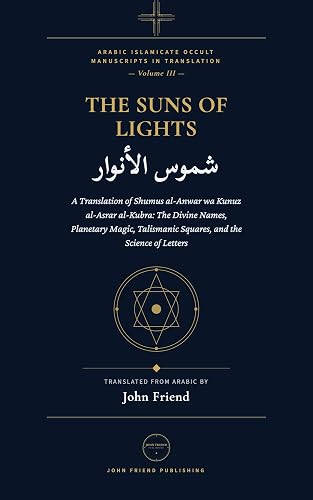
Vol. III Cover of Suns of Lights and the Great Treasures of Secrets — Shams al-Anwar wa Kunuz al-Asrar al-Kubra by Ibn al-Hajj al-Tilmsani, an Arabic grimoire of divine names, planetary magic and talismanic squares in English translation

Suns of Lights & the Great Treasures of Secrets

Shams al-Anwar wa Kunuz al-Asrar al-Kubra

Ibn al-Hajj al-Tilmsani (1327 CE) Translated by John Friend Vol. III 264 pages Free with Kindle Unlimited

In English for the first time in 700 years. The 99 Beautiful Names of God (al-Asma al-Husna), magic squares (awfaq) from the 3×3 to the 9×9 planetary, the seven planetary spirits with their incenses and timing, and the science of Arabic letter magic. A foundational manual of the same Islamicate tradition as the Shams al-Ma’arif.

Vol. IV Cover of Kitab al-Ajnas — The Solomonic Grimoire of Asif ibn Barkhiya, an Arabic occult manuscript in complete English translation

Kitab al-Ajnas: The Book of the Races

The Solomonic Grimoire of Asif ibn Barkhiya

Asif ibn Barkhiya Translated by John Friend Vol. IV 362 pages Free with Kindle Unlimited

The first complete English translation of one of the most important Solomonic grimoires of the Arabic tradition — attributed to Asif ibn Barkhiya, the legendary vizier and chief minister of Prophet Sulayman (Solomon). Voces magicae preserved exactly; talismanic seals reproduced from the source.

Vol. VI Cover of Tumtum al-Hindi — The Book of Tumtum the Indian, an Arabic grimoire of stellar magic, talismans, and love spells in English translation

Tumtum al-Hindi: The Book of Tumtum the Indian

An Arabic Grimoire of Stellar Magic, Talismans & Love Spells

Tumtum al-Hindi Translated by John Friend Vol. VI 298 pages Free with Kindle Unlimited

One of the most celebrated grimoires in the Arabic occult tradition — attributed to a legendary Indian sage whose esoteric knowledge entered the Islamic magical corpus. Stellar magic, talismanic operations, and the great corpus of attraction (jalb), excitation (tahyij), and love (tahbib).

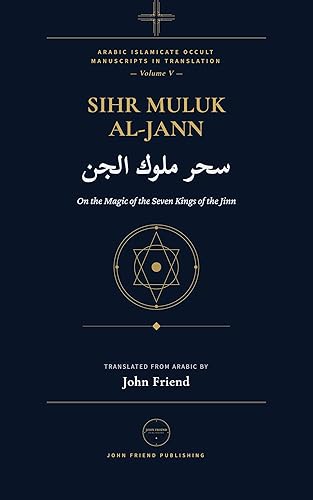
Vol. VII Cover of The Complete Magic of the Jinn Kings — Sihr Muluk al-Jann, A Manual of Conjuration for the Seven Kings of the Jinn, an Arabic grimoire in English translation

The Complete Magic of the Jinn Kings

Sihr Muluk al-Jann

Translated by John Friend Vol. VII 241 pages Free with Kindle Unlimited

A medieval Arabic grimoire and practical manual for the conjuration of the seven kings of the jinn within the Solomonic tradition — specific seals, divine names, adjurations, ritual procedures, and the behavioral and purification protocols required of the practitioner.

In Translation

More Translations in Production

al-Makhtutat al-Atiya

Forthcoming Subscribe to the Author Page

Additional Arabic occult manuscripts are in active translation — further volumes of sihr, ruhaniyat, planetary magick, and Solomonic theurgy. Follow on Amazon to receive new-release notifications the moment they publish.

Stockists

Our books are stocked by these amazing bookstores

Bookstores & retailers: order direct from the publisher

Stock the first English translations of the Arabic grimoire tradition. Trade orders come straight to the press, at 45% of the US list price: tell us what you would like to carry and we will reply with availability and shipping.

Email to order wholesale Trade list & wholesale details

The Hidden Tradition

The Sciences of Sihr, Ruhaniyat & Theurgy

The books on this list cover four Arabic occult sciences: sihr, ruhaniyat, awfaq and the divine names. Each title is translated from the Arabic and appears here in English for the first time.

SihrArabic Magic

The operative magical sciences of the Islamicate world — from the talismanic and astral magic of al-Buni and al-Tilmsani to the practical conjurations preserved in manuscript across the Maghrib and Mashriq.

RuhaniyatSpiritual Science

The science of the ruhaniya — the planetary and stellar spirits, the angels of the divine names, and the kings of the jinn — together with the protocols for their licit conjuration.

AwfaqMagic Squares

The construction of awfaq, magic squares from the 3×3 to the 9×9 planetary, and their application as talismans tuned to specific divine names, planetary spirits, and operational ends.

al-Asma al-Husna99 Names of God

The 99 Beautiful Names of God examined for spiritual properties, numerical (Abjad) value, planetary correspondence, and talismanic application — the engine of Islamic letter magic.

Lineage of the Tradition

From al-Buni to the Picatrix — the Hidden Genealogy

The Arabic occult corpus is the unseen root of nearly every Western grimoire. Here is where these volumes sit in that lineage — and what readers of the Picatrix, the Lesser Key of Solomon, or Shams al-Ma’arif will recognize.

al-Buni & Shams al-Ma’arifThe Foundational Corpus

Ahmad ibn Ali al-Buni (d. 1225 CE) compiled the Shams al-Ma’arif al-Kubra, the most influential Islamic occult work ever written. Our volume Shams al-Anwar wa Kunuz al-Asrar al-Kubra by Ibn al-Hajj al-Tilmsani (1327 CE) belongs to the same operational lineage: divine names, magic squares, planetary spirits, letter mysticism (ilm al-huruf) — the engine al-Buni systematized.

Picatrix & Ghayat al-HakimThe Lost Arabic Original

The famous Latin Picatrix is itself a translation of the 11th-century Arabic Ghayat al-Hakim. Astrological talismans, planetary hours, conjuration of the spirits of the spheres — all the operational machinery in our volume al-Jawahir al-Lamma’a draws from this same astral-magic stratum, in the language it was actually composed in.

Solomonic & Goetic MagicThe Eastern Source of the Lemegeton

The Lesser Key of Solomon, the Goetia, and the entire Solomonic cycle of Western ceremonial magic descend from Arabic and Hebrew prototypes. Our Kitab al-Ajnas of Asif ibn Barkhiya — vizier to the Prophet Sulayman — and our Sihr Muluk al-Jann are the Arabic Solomonic source-tradition, naming the same kings of spirits as their Latin and Greek descendants.

Western EsotericismThe Crossroads

Hermeticism, ceremonial magick, theurgy, witchcraft — the operative side of the Western mystery tradition has Arabic fingerprints throughout. These translations close the gap, giving English readers direct access to the Arabic source-texts that European occultism drew on.

A Guide to the Library

Islamic Occult Books & Arabic Magic — What the Manuscripts Contain

Every title here comes from the Arabic manuscript tradition and circulated for centuries in handwritten form before reaching English — from Islamic occult manuscripts of talismans, magic squares, and spirits to Islamic esoteric manuscripts of prayer and the divine names. Here is what these occult manuscripts actually teach, and which volumes answer the questions readers most often bring to them.

IslamicateA Shared Arabic Culture

Islamicate names the wider culture shaped by Islam, not the religion alone — which is why the library sets The Tested Remedies of the Monks, a Christian-Arab compilation, beside al-Buni and the Solomonic grimoire of Asif ibn Barkhiya. Every Islamic occult manuscript here survives in Arabic and is translated directly from the Arabic.

Letters, Numbers & SquaresThe Engine of Arabic Magic

Much of Arabic magic runs on the science of letters, ilm al-huruf, which gives each Arabic letter a number, an element, and a spirit, and on the awfaq, the magic squares that turn those numbers into talismans. Al-Buni’s Usul ‘Ilm al-Huruf divides the alphabet into luminous and dark letters; his Manba’ Usul al-Hikma gives the construction methods for odd, even, and even-odd squares.

Kings of the JinnMuluk al-Jinn

Several Arabic grimoires in the library deal with the seven jinn kings. The Complete Magic of the Jinn Kings is a manual devoted to them; Kitab al-Ajnas gives invocations and a seal over all seven kings; and The Radiant Jewels ranks the seven kings as the greatest of the jinn, each tied to one of the seven days and one of the seven planets. Their names, and how they differ from the Western Goetia, are set out in the real names of the seven jinn kings.

Spiritual Science or Sorcery?Ruhaniyat & Sihr

Islamic magic books are often filed under “black magic.” The manuscripts draw their own line, between ruhaniyat, the lawful science of spirits approached through prayer, fasting, and purity, and sihr, sorcery — and The Complete Magic of the Jinn Kings even includes a rite for the nullification of sorcery and magical bindings. Our essay on spiritual science, sorcery, and black magic in the Arabic sources shows where that line falls.

Common Questions

About the Translations & Arabic Occult Books

What is John Friend Publishing?
John Friend Publishing is a press devoted to first complete English translations of Arabic occult manuscripts. It publishes two book series — the Al-Buni Manuscripts Collection (eight volumes) and Arabic Islamicate Occult Manuscripts in Translation (seven volumes) — with more translations in production. Every volume is translated from the Arabic by John Friend and is available on Amazon in Kindle and print editions.
What is the Arabic Islamicate Occult Manuscripts series?
It is an ongoing series of first-ever complete English translations of medieval Arabic grimoires — currently including the Kitab Danyal al-Nabi, Mujarrabat al-Ruhban, Shams al-Anwar wa Kunuz al-Asrar al-Kubra, Kitab al-Ajnas of Asif ibn Barkhiya, al-Jawahir al-Lamma’a, Tumtum al-Hindi, and Sihr Muluk al-Jann — translated and published by John Friend Publishing. Additional volumes are in active translation.
Is Shams al-Anwar related to Shams al-Ma’arif?
Yes — both belong to the same Islamicate occult tradition centered on the Names of God, planetary magick, magic squares (awfaq), and letter magic. Shams al-Anwar wa Kunuz al-Asrar al-Kubra by Ibn al-Hajj al-Tilmsani (1327 CE) is a foundational seven-century-old grimoire of the same lineage as the Shams al-Ma’arif al-Kubra attributed to al-Buni.
Are these translations academic or for practitioners?
Both. Each volume preserves the original Arabic alongside scholarly IJMES transliteration and faithful English translation. Talismanic seals, magic squares, and voces magicae are reproduced exactly from the source manuscripts. Intended for scholars, historians of religion, and serious students of the Western and Islamic esoteric traditions.
Where can I buy these books?
All currently published volumes are available on Amazon as Kindle eBooks (free to read with Kindle Unlimited), and all are also in paperback; the seven volumes of the Arabic Islamicate Occult Manuscripts series are in hardcover too. New translations join the library as they release. Direct buy links for each title are above in the Library section. Bookstores can order print copies directly from the publisher — see the wholesale question below.
How does this relate to al-Buni and the Shams al-Ma’arif al-Kubra?
Ahmad ibn Ali al-Buni (d. 1225 CE) is the foundational figure of the Arabic occult tradition; his Shams al-Ma’arif al-Kubra systematized the science of divine names, magic squares (awfaq), planetary spirits, and letter mysticism (ilm al-huruf). Our volume Shams al-Anwar wa Kunuz al-Asrar al-Kubra by Ibn al-Hajj al-Tilmsani (1327 CE) is from the same operational lineage and uses the same machinery — making it a direct doorway for any reader interested in al-Buni’s tradition. The Shams al-Ma’arif al-Kubra itself is now available in complete English translation — all 40 chapters — as Vol. I of the Al-Buni Manuscripts Collection, alongside seven further volumes.
Is this related to the Picatrix or Ghayat al-Hakim?
Yes. The Latin Picatrix is a translation of the 11th-century Arabic Ghayat al-Hakim, and the same astral-magic, planetary-hour, and talismanic operational logic runs through the Arabic occult tradition. Our al-Jawahir al-Lamma’a (planetary hours and jinn-king conjuration) and our Shams al-Anwar (planetary spirits and magic squares) sit squarely in that same astrological-magic stratum — in the original language. For what the Arabic Ghayat al Hakim itself contains, see our essay Picatrix vs. Ghayat al-Hakim.
Is this useful for readers of the Lesser Key of Solomon / Goetia?
The Solomonic cycle of Western ceremonial magic descends in part from Arabic and Hebrew prototypes that name the same kings of spirits and use the same conjuration logic. Our Kitab al-Ajnas of Asif ibn Barkhiya (vizier to the Prophet Sulayman) and our Sihr Muluk al-Jann ("Magic of the Jinn Kings") are the Arabic Solomonic source-stream that the Lemegeton and Goetia grew from.
Do the books include the original Arabic and seals?
Yes. Prayers, invocations, divine names, and Quranic passages are presented in three layers: English translation, IJMES romanized transliteration, and the original Arabic script. Talismanic squares, geometric seals, and ciphers are reproduced as images from the source manuscripts to preserve their ritual integrity.
What are Arabic grimoires?
Arabic grimoires are handbooks of the occult sciences written in Arabic: manuals of talismans, magic squares (awfaq), the science of letters (ilm al-huruf), the divine names, planetary timing, and the conjuration of spirits and jinn kings. Most circulated for centuries as handwritten manuscripts rather than printed books. The fifteen volumes in this library are Arabic grimoires and related devotional and Sufi texts, each in complete English translation.
Where can I find Islamic occultism books in English?
The library on this page brings together fifteen Islamic occultism books in complete English translation, from al-Buni’s Shams al-Ma’arif al-Kubra to Kitab al-Ajnas and The Complete Magic of the Jinn Kings. All are sold on Amazon, and the Kindle editions can be read free with Kindle Unlimited. For background, the essay archive on Islamic occultism covers the tradition in depth, and our guide to Islamic occultism books in English notes what other publishers have translated.
Which Islamic magic books should I read first?
Start with your subject. For letter magic, lunar mansions, and the divine names, begin with Shams al-Ma’arif al-Kubra; for Solomonic magic, Kitab al-Ajnas; for the jinn kings, The Complete Magic of the Jinn Kings and The Radiant Jewels; for astrology and prognostication, The Book of the Prophet Daniel; for protective prayers, Majmu’at al-Awrad. Our guide to every Arabic occult manuscript in English maps the wider field.
Can bookstores order these books wholesale?
Yes. Bookstores and occult, esoteric, and metaphysical shops can order print editions directly from the publisher. Send wholesale inquiries to hello@johnfriendpublishing.com with your store name and the titles you would like to stock.

Direct Contact

Inquiries, Wholesale & Manuscripts

For private inquiries, manuscript submissions, and rights requests — reach the press directly.

Bookstores and occult, esoteric, and metaphysical shops: print editions are available directly from the press. Email wholesale inquiries with your store name and the titles you would like to stock.

hello@johnfriendpublishing.com